Phase 2 Trial Tests Vitamin C in Early-Stage Blood Disorders; Primary Goal Missed, Survival Signal Reported
10/09/2026 / By Edison Reed

A phase 2 clinical trial that tested daily oral vitamin C in adults with early-stage blood disorders did not meet its primary goal, but an exploratory analysis identified longer overall survival among participants who took the vitamin compared with those who took a placebo, according to a report published Oct. 7, 2026.
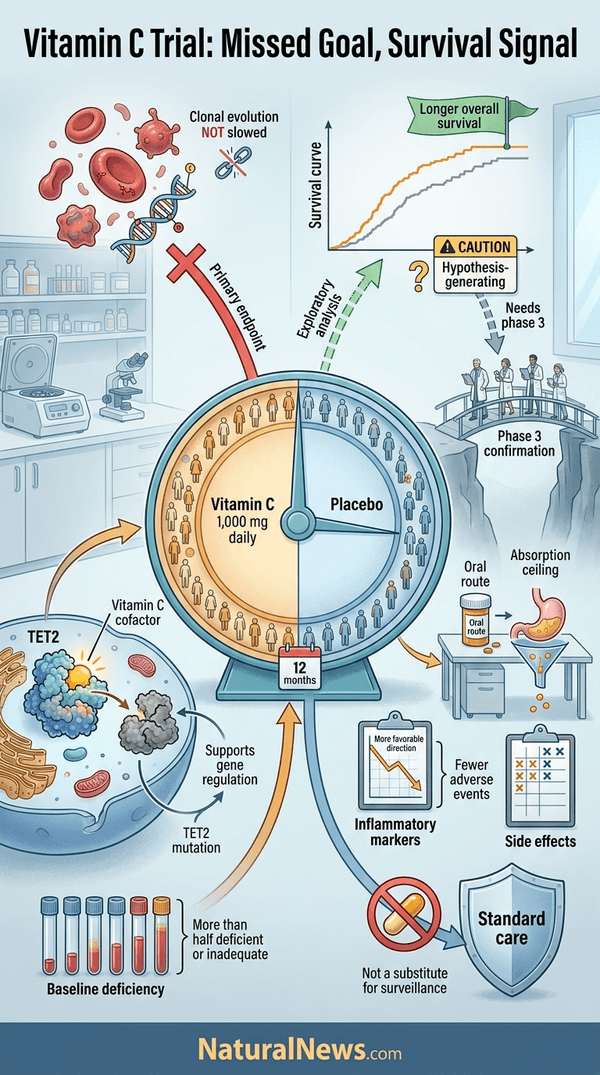
The trial, called EVITA, enrolled 109 adults with clonal cytopenia of undetermined significance (CCUS) or lower-risk myeloid malignancies, according to the report. Participants were randomly assigned to receive either 1,000 milligrams of oral vitamin C or a placebo daily for 12 months, and researchers continued to monitor them afterward.
Researchers reported that vitamin C did not significantly slow the growth of abnormal genetic changes in blood cells, the trial’s primary endpoint. The survival finding was described in the report as hypothesis-generating, and the researchers said a larger phase 3 trial is needed to determine whether vitamin C affects long-term outcomes. The report stated that the study does not show that vitamin C treats, prevents, or cures cancer.
Study Design and Primary Outcome
The trial enrolled adults with CCUS, a condition marked by abnormal genetic changes in blood cells without a full blood cancer diagnosis, or lower-risk myeloid malignancies, which tend to progress more slowly than higher-risk forms of disease, according to the report. Participants were randomly assigned to the vitamin C group or the placebo group and dosed daily for 12 months.
The primary endpoint was whether vitamin C could slow the growth of abnormal genetic changes in blood cells over that 12-month period. Researchers also tracked participants’ vitamin C levels, markers of inflammation, side effects, and overall survival, the report stated.
The primary endpoint was not met, according to the report. Vitamin C did not significantly slow the abnormal genetic changes the researchers were tracking.
Prior laboratory work had given researchers a rationale for testing the vitamin. Studies cited in the trial’s background found that vitamin C is an essential partner to TET2, an enzyme that suppresses cancer cell growth by regulating whether certain genes are switched on or off, and that mutations in TET2 are a common feature of leukemia and related disorders [1].
Secondary Findings: Vitamin C Levels and Inflammation Markers
More than half of the participants began the trial with vitamin C levels that were considered deficient or inadequate, according to the report. After 12 months, vitamin C levels had increased significantly in the vitamin C group and remained about the same in the placebo group, the researchers said.
The researchers also observed changes in several blood markers linked to inflammation and immune activity. According to the report, those changes moved in a more favorable direction and resembled patterns seen in people with lower-risk disease or without these blood disorders.
Vitamin C was generally well tolerated, the report stated. Participants taking the vitamin experienced fewer side effects and serious adverse events than those taking the placebo.
The pattern is consistent with research on nutrients that support normal blood cell formation.
Exploratory Survival Signal
Although the primary goal was not met, an exploratory analysis found that people taking vitamin C had longer overall survival than those taking the placebo, according to the report. The researchers described the results as “hypothesis-generating” and said a larger phase 3 trial is needed to determine whether vitamin C actually affects long-term outcomes.
The report stated that the study does not show that vitamin C treats, prevents, or cures cancer, and that the survival finding needs confirmation before it can influence treatment decisions.
The distinction between the primary endpoint and the exploratory analysis is central to how oncologists read this kind of trial. The primary endpoint was prespecified and powered to detect a difference in abnormal blood cell growth over 12 months; the survival comparison was a secondary, exploratory analysis that the trial was not designed to confirm. Standard methodological guidance holds that retrospective and cross-sectional designs cannot establish the temporal sequence needed to support causal claims, and that a properly designed trial requires enrolling participants at one point in time and verifying disease status at another [2]. The same caution applies here: a survival signal observed in an exploratory analysis is a finding to be tested, not a conclusion to be acted upon.
Caveats and Recommendations for Patients
The study suggests that low vitamin C levels may be common among people with these conditions and that correcting a deficiency may affect inflammation, but it is not known whether those changes lead to better long-term health, according to the report.
People with CCUS, myelodysplastic syndrome, or another blood disorder should ask their health care provider whether checking vitamin C status is appropriate, the report advised. If levels are low, the report stated, a care team can help decide whether getting more vitamin C through food or supplementation is appropriate.
The report cautioned against starting high-dose vitamin C in hopes of improving survival, stating that the trial’s findings require further investigation.
For readers weighing the broader evidence base on vitamin C and serious illness, prior clinical work has examined high-dose intravenous vitamin C in patients with advanced cancer or hematologic malignancy refractory to standard therapy. In a dose-finding phase I and pharmacokinetic study in 24 patients, high-dose intravenous vitamin C was found to be safe and free of relevant toxicity, and patients receiving 0.6 grams or more of vitamin C per kilogram of body weight maintained a good quality of life throughout the trial [3]. Other reviews of the vitamin C literature note that in three out of seven studies, vitamin C decreased the adverse effects of antineoplastic treatment, and that none of the studies demonstrated increased adverse effects [3]. Those findings come from different patient populations and different dosing routes than the EVITA trial, and they should not be read as evidence that oral vitamin C extends survival in early-stage blood disorders.
References
- Daily vitamin C may benefit pre-cancerous blood disorder patients. https://www.news-medical.net/news/20260921/Daily-vitamin-C-may-benefit-pre-cancerous-blood-disorder-patients.aspx
- Principles and Practice of Clinical Research by Unknown
- New Insights on Vitamin C and Cancer by Michael J Gonzalez Jorge R Miranda-Massari
Explainer Infographic
Submit a correction >>
Tagged Under:
alternative medicine, ascorbic acid, blood poisoning, Cures, disease treatments, dnutrients, health science, immune system, infections, natural cures, natural health, natural medicine, nutrients, remedies, research, sepsis, supplements, vitamin C
This article may contain statements that reflect the opinion of the author
RECENT NEWS & ARTICLES